- Subject
- Microsoft 365 & SharePoint
- Filed
- Source
- Ranveer Chandra
- Loans
- 664
Microsoft Frontier Tuning Expands Private Preview With Team Tools and More Models
Microsoft is expanding Frontier Tuning to more customers, adding team tools, model choices and a workflow for improving tuned agents after launch.
Microsoft is expanding access to Frontier Tuning and adding tools that let customer teams build, evaluate and maintain tuned agents. The private preview now includes a GitHub Copilot plugin, command line tools and APIs, publishing to Cowork, and two additional models. For IT and AI teams, the main change is a shift toward letting in-house makers and subject matter experts run more of the tuning work themselves.
Microsoft first introduced Frontier Tuning at Build in June and began with a focused private preview. Those early customers worked with Microsoft Forward Deployed Engineers to define tasks, set evaluation criteria and run tuning. Microsoft says what it learned from that process informed the tools now available to private preview customers. The expanded preview is open to more customers in the Frontier program.
New tools give teams more control over tuning
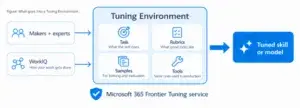
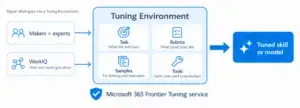
The Frontier Tuning plugin for GitHub Copilot is intended to help makers and subject matter experts build a Tuning Environment together. Microsoft says the plugin draws on Work IQ to reflect how work is carried out. The Frontier Tuning command line interface and APIs give developers another route: they can run tuning from tools they already use and incorporate tuned skills into their own agents.
Teams can also publish a tuned skill to Cowork as a plugin after makers approve it. Users can share work examples back to the Tuning Environment when they encounter a case that could help inform later improvements. This creates a feedback path between how a skill performs in use and the samples a team may consider in a future tuning round.
Two models are available for tuning in the private preview: GPT 6 Luna and MAI Code 2 Flash. The choice of model sits alongside a separate decision about what the team wants to tune. Microsoft says many teams begin by improving the skill itself, which allows them to work across supported models. When they need a different approach, model tuning can bring their expertise into a model managed by their organization.
Tuning is also planned for Microsoft Copilot Studio in the near future. Microsoft says makers will be able to evaluate and tune skills there using a similar approach, with more details to come closer to availability. No specific release date is provided.
Evaluation happens before a version reaches users
A Tuning Environment contains four elements: the task, rubrics that define good work in the terms used by the organization’s experts, training and evaluation samples, and the tools the skill uses in production. Keeping these elements together gives a team a way to assess a tuned version against cases it wasn’t trained on. That distinction matters: a strong result on training examples alone doesn’t show how well a skill will handle other work.
Microsoft describes the tuning process as hill climbing. Each round produces a new version, grades it against the team’s rubrics using evaluation samples, and builds on changes that improve the result. Makers review the outcomes and decide whether any version should move to users. The Microsoft 365 Frontier Tuning service manages the samples, tools, rubrics and tuned models, with secure storage and access controls.
The quality of the materials in the Tuning Environment shapes what a team can learn from the process. Rubrics need to capture how experts judge good work; samples need to represent relevant cases; and the environment should include the tools and knowledge the skill uses in production. Teams setting up a pilot will need people who can define those standards and provide representative examples. The tools can support the iteration, but the organization’s own evaluation criteria determine what counts as an improvement.
EY applies its standards to tax research
EY is tuning its Tax Advisor agent to help tax professionals research more effectively. EY’s professionals retain responsibility for the advice they give clients. The company’s tax experts encoded their methodology, voice and review standards as rubrics, then connected the Tuning Environment to the precedent search used by the agent in production.
Benjamin Ambrosino, EY Global Tax Chief Technology Officer, said: “EY’s tax methodology and review standards are what make our advice trustworthy. Encoding them as rubrics let a small model learn to research, cite and hedge the way our professionals do, and on our own quality bar it now outperforms a frontier model.” That comparison is Ambrosino’s account of EY’s result, measured against the company’s own quality bar.
Plan for ongoing review after launch
A tuned skill may need another round when work requirements change or a team wants to try a different model. Users in Cowork can choose to share examples from their work with the Tuning Environment. The team can then refresh its samples, revise rubrics and run another tuning round, using the same evaluation approach to compare a new version with the one currently in use.
For administrators and project owners, that ongoing loop makes ownership and review part of the operating model. Teams should decide who can contribute examples, who maintains the rubrics and who approves a version for users. The source material doesn’t specify additional access configuration or deployment commands, so organizations should follow the product guidance available to their preview participants.
Microsoft says there’s no charge for Frontier Tuning during the private preview. Pricing details are expected before broader availability, but no price or timing has been provided. Customers in the Frontier program can sign up at aka.ms/FrontierTuning. For teams considering the preview, the practical starting point is a specialized task with clear expert standards, usable examples and an evaluation process that can distinguish a better result from a merely different one.