- Subject
- Microsoft 365 & SharePoint
- Filed
- Source
- Laura Varley
- Loans
- 608
Trinity College Dublin Opens Docklands Innovation Hub for Research and Spin-outs
Trinity’s new Docklands hub brings researchers, companies and spin-outs together across AI, healthcare, energy and deep tech.
Trinity College Dublin has opened a new space in Dublin’s Docklands to bring university researchers closer to companies and entrepreneurs working on new technologies. The Trinity Innovation Hub, based at Trinity East, is intended to support collaboration and help ideas move toward economic and societal use.

The hub’s significance will depend on the work its members can do together. Co-location gives researchers, established organisations and young ventures a shared place to develop connections, compare needs and explore potential applications. That can make it easier to identify where academic research might meet a commercial or practical problem. The university describes the hub as a way to strengthen those links and support innovation and job creation in Ireland.

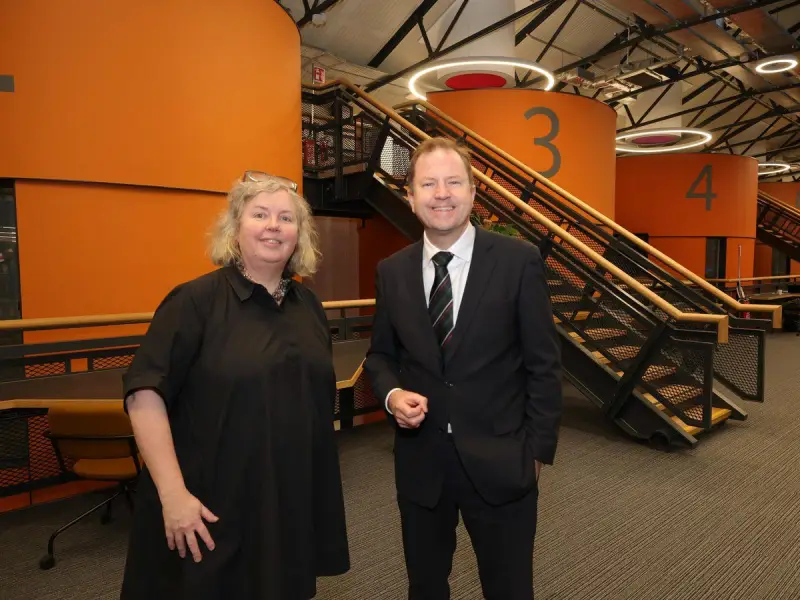
From left: Dr Linda Doyle and James Lawless, TD. Image: Fennell Photography

A mix of established organisations and spin-outs
Membership includes established companies and organisations, alongside a growing group of high-potential spin-outs. Those ventures are developing ideas and technologies in healthcare, artificial intelligence, energy, reinsurance and deep tech. The range points to a hub intended to serve several fields, rather than one industry or research discipline.

Named members include Rinn Advanced Therapeutics and Rinn Quantum, as well as Trinity spin-outs Plio Surgical and eAltra. Their presence gives the hub a practical test: whether a shared location can help teams make useful connections across different stages of development and areas of expertise. The available details do not set out specific programmes, facilities, membership costs or performance targets, so the hub’s progress will be judged through the collaborations and work that emerge.
For research organisations and companies, a hub can provide a setting for regular contact that is harder to establish through occasional meetings alone. Researchers can explain what their work can do; companies can bring questions about real-world needs; and early-stage ventures can meet potential collaborators. These are possible benefits of the model, rather than outcomes already demonstrated by the new space.

Collaboration is the test
Trinity director of innovation Vincent Coole said the hub is designed to enable co-location, deeper collaboration and strategic relationships. He pointed to Station F in Paris and Lab Central in Boston as examples of innovation spaces, and said the ambition is to build a community of people who develop and act on new ideas.
That ambition puts the emphasis on what happens inside the hub, not simply on its location. A shared address may create more opportunities for conversation, but sustained work depends on researchers and external organisations finding common problems and deciding how to pursue them. For spin-outs, connections with established organisations could be useful as they develop technologies; for larger members, access to research expertise may help them assess new approaches. The university has not specified particular projects or results, so those possibilities remain areas to watch.
The hub’s stated focus also links research with commercial opportunities and wider social impact. That combination can involve different measures of success: a venture may be working to develop a product, while a research team may be focused on a scientific or societal challenge. How the hub supports those different aims will help clarify its role within Trinity’s wider innovation activity.
What to watch next
The opening establishes a place for researchers, entrepreneurs, organisations and spin-outs to work in closer proximity. The next useful indicators will be the collaborations formed, the technologies developed by member ventures and whether the hub helps research reach practical applications. No timetable or quantified targets for those outcomes have been provided.
For teams considering how university research can connect with business needs, Trinity’s Docklands hub offers a new setting to follow. Its broad mix of sectors creates room for cross-disciplinary work, but the value will come from concrete projects and lasting relationships. The clearest measure will be what members build together from the ideas and expertise brought into the space.