- Subject
- Excel & Power BI
- Filed
- Source
- Dave Vellante
- Loans
- 717
Can Enterprise AI Revenue Catch Up With Infrastructure Spending?
AI use is spreading across enterprise workflows, but lasting returns depend on redesigned work, measurable customer value and disciplined compute costs.
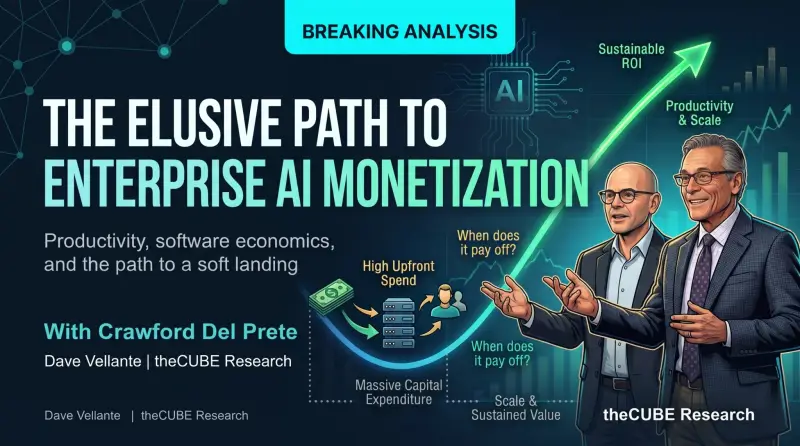
Enterprise AI demand is growing faster than many companies can measure its financial return. That gap matters for a buildout financed on the expectation that businesses will eventually pay enough for AI services to support model development, computing capacity and the commitments linking them.
The practical test is whether AI becomes part of how companies produce and sell work, rather than an extra tool employees use for isolated tasks. Crawford Del Prete, former president of IDC and now a senior adviser at PSG Equity, sees broad experimentation and early productivity gains. He also sees the harder work ahead: redesigning workflows, tracking value and deciding which compute and models fit each job.
Demand is real, but uneven
Some customers already say they can use every server an original equipment maker can supply. Del Prete described one quantitative business that wanted all the capacity available from Lenovo, HPE and Dell. Its employees use the additional compute to produce analyses and deliverables they could not create before. For that customer, capacity is directly tied to work it values.
That experience doesn’t describe every enterprise. Other buyers are beginning to track token consumption and match models to tasks. They may reserve a more capable model for work that needs it and use a less expensive option for routine requests. Del Prete expects a mix of models for different workloads, including open-source and open-weight models deployed in a company data centre or cloud environment.
That kind of selection is familiar to infrastructure teams. Organizations already choose compute configurations according to the application, performance target and cost. AI adds new variables: the model’s quality on a particular task, how much inference it uses, where the data can run and whether a cheaper model is good enough. The buying process is still developing, but model choice is becoming part of workload management.
For now, many customers continue to spend because they need to remain competitive and give employees access to tools that can expand what they do. Del Prete says the amount they can spend depends on their available resources. He also sees software companies investing in AI across the board, since they face pressure to improve their products and defend their market position.
That pressure comes from two directions. A large platform may use AI to absorb work that previously belonged to a specialist software vendor. Customers may also build their own applications with AI coding tools instead of licensing a product. Software companies are therefore weighing AI investment against the risk of losing customers, even when the direct return from an AI feature is not yet clear.
Task gains need a change in how work is organized
AI can automate individual tasks without changing the structure of a job. A role may contain hundreds or thousands of separate activities, and automating some of them can give an employee more capacity while leaving the surrounding workflow intact. That helps explain why people can report a clear productivity improvement while company wide productivity measures show little movement.
Del Prete sees early use in coding and customer service, followed by automation in other parts of organizations. In general businesses, the gains may come from a steady stream of smaller tasks. Some of the added output is work that never made it onto a formal plan: a business case that was not written, a scenario that was not modelled, or a presentation that was never produced because the team lacked time.
That extra work is difficult to measure. If AI lets an employee complete more analysis, the result may be a better decision or a new project rather than a lower payroll expense. The company may not see an immediate change in revenue or costs, even though the employee can produce more. To capture a larger return, organizations need to raise output per person, limit the need to hire for added demand or redesign the process so those gains can be repeated across teams.
Del Prete contrasts this work with traditional robotic process automation. RPA required organizations to document a process, code the steps and then maintain the automation. With generative AI, employees can start from a pain point and describe a better way to handle it in natural language. Teams can then turn useful approaches into projects or reusable skills and share them across the organization.
In leading organizations, this work can start with employees explaining how they get around longstanding problems. Del Prete describes internal AI sessions as a way to find those workarounds and consider whether they can become repeatable practices. The goal is to take a solution that helps one employee and make it available to others. That turns informal task improvement into a chance to change the workflow.
The distinction is important for IT leaders. Giving staff access to a chatbot or coding assistant can increase personal output, but it doesn’t by itself create an organization wide operating change. Leaders need a way to identify valuable uses, assess whether they can be shared and connect them to business outcomes. Otherwise, adoption may grow without producing a clear return on the infrastructure and software costs.
Why returns may take time to appear
The delay between adoption and measurable productivity is consistent with the productivity J-curve described in research by Erik Brynjolfsson, Daniel Rock and Chad Syverson. The idea is that organizations first spend time and money learning a new technology and making complementary changes. Those costs can push cumulative returns down before redesigned processes and broader deployment begin to produce gains.
For AI, the early costs may include compute, software, training, data work and changes to how teams operate. Some of that investment is intangible: it may improve how work is done without appearing as a separate asset or immediate saving. A company can therefore see employees working faster while its financial statements still reflect the expense of adoption.
Del Prete points to the personal computer era as a reminder that technology adoption and organization wide productivity do not move in lockstep. He estimates that it took 13 or 14 years after the PC was introduced for productivity gains to become visible. The period from 1996 to 2002, when connectivity spread, helped unlock more of the value.
His examples from that era are concrete. At one workplace, researchers wrote reports by hand and queued to enter them into a shared Wang terminal. In a commercial lending department, employees took turns using a single IBM PC for spreadsheet work. They first worked out calculations on graph paper, then transferred them to the computer. Companies had useful tools before they had reorganized work around them.
Broad PC adoption required more than buying computers. Staff needed training in Lotus 1-2-3, and businesses had to absorb the cost of hardware and new working practices. Del Prete recalls the eventual organizational reset at IDC, including the decision to discontinue Dataquest. The wider lesson is that individual productivity can improve well before a company changes its processes, staffing and product strategy.
The internet offers a related example. The first wave of infrastructure did not immediately produce the later benefits associated with broadband, Web 2.0 and online advertising. The technology needed faster connections, new services and more measurable ways to transact. A productive technology can therefore be overbuilt or overhyped in its early phase and still support durable business changes once the missing pieces arrive.
Del Prete sees one difference in the current AI cycle: he says the GPUs being deployed are used at full capacity as soon as they come online. During the dot-com period, dark fibre created a long stretch of excess capacity before demand caught up. High use today is evidence of demand for compute, but it does not by itself prove that customers can earn enough from that use to support the full cost of the systems.
Access alone won’t create institutional change
Del Prete offered a small but vivid example of how dependent some teams have become on AI tools. While working at a private equity firm, he saw Claude return a message suggesting the team had run out of credits. He checked with colleagues and found associates standing up from their desks to ask one another whether the service was down. Their work had become closely tied to the tool.
That episode shows adoption, not a complete financial return. Del Prete’s concern is that organizations may distribute Claude, Copilot or another assistant and then expect the operating model to change on its own. If employees don’t share useful practices and leaders don’t redesign the work, a company can end up with widespread use but little institutional improvement.
He also sees a wide gap between typical users and employees at the leading edge. Many white-collar workers have a basic understanding of how AI can help, while advanced users are finding ways to accomplish much more. Tools that are easier to use could extend adoption to small and midsize businesses and to routine consumer tasks. Del Prete cited Meta Muse as an example of the kind of interface that may make some AI uses more accessible.
The adoption curve will still vary. A simple assistant can help with a single task, while an agent that takes actions across business systems raises questions about access, accuracy and accountability. Enterprises are unlikely to trust AI with every critical action immediately. Human review remains part of the design for many important processes.
Security and accountability become part of the product
AI is also changing how companies approach old code and technical debt. Del Prete says security has become a major area of activity as advanced models are applied to large bodies of software. Companies that previously lacked a strong reason to refactor code may now have tools that help them examine and update it. He also points to the discovery of vulnerabilities by advanced models as a reason organizations need to address security work.
That investment can be valuable even if it does not produce an immediate productivity metric. Fixing code and improving software security may reduce risk and make future changes easier. But companies still need to distinguish between a tool’s ability to suggest changes and the organization’s responsibility for reviewing and deploying them.
Del Prete frames next generation software around three layers: execution, judgment and accountability. Execution is the routine work that moves information through a system, such as recording a customer name or storing call details in a CRM. AI can increasingly carry out that computational work. The judgment layer produces analysis or recommendations from the available data, and AI is beginning to handle more of that as well.
Accountability is the layer companies are working hardest to define. Someone must answer for a decision made at 2 a.m., a compliance record or an action taken on a customer’s behalf. AI can generate an insight and act on it, but the company still needs to decide who reviews the result, who has authority to approve it and who is responsible when it is wrong.
This changes the role of software vendors and customers. Vendors need to build products that work as represented and provide useful controls. Customers remain responsible for deciding where a system can act, what safeguards are needed and which decisions require human involvement. Del Prete calls this a shared accountability model, with responsibility distributed between the customer and the companies providing the tools.
Software that is embedded in difficult workflows may have an advantage because it already captures useful customer data and supports important work. Systems of record and systems of action can become more valuable when AI uses their data to automate steps or improve decisions. But the value depends on whether those systems can support trustworthy actions and provide a clear path for human oversight.
Compute economics depend on where workloads run
Examples from enterprise AI deployments show why a technical proof of concept is not the same as a viable service. A healthcare and biotech customer moved from burst training to permanent inference and reported good cost and performance, along with early monetization. That is a positive case, but other customers described obstacles between getting a system to work and making the business case work.
A Canadian managed service provider completed a technical proof of concept but held back from scaling its customer facing AI product while it tested demand and product market fit. A successful demonstration did not tell the provider whether customers would pay enough to support the service.
Some organizations want to run AI on premises for data sovereignty, latency or financial control. One infrastructure and operations executive said the company needed 80% GPU utilization to break even. Hyperscalers and specialized cloud providers can pool demand across many customers, while a single enterprise may struggle to keep its own equipment busy enough. If utilization stays low, owning the hardware can cost more than paying a cloud provider.
A German enterprise chose to remain on Azure after evaluating CoreWeave. The company saw technical advantages in adding another cloud but judged the extra operating overhead too high. Its existing Azure relationship and credits made the familiar option easier to use. Such decisions show that performance and unit cost are only part of the calculation; staffing, integration and operational complexity also affect the economics.
Del Prete expects organizations to test hybrid arrangements rather than choose only between a private data centre and a public cloud. An open-weight or open-source model supplied through a cloud provider could let customers benefit from capacity shared across users while retaining more choice about the model. New compute providers may add supply and affect prices, while more efficient AI software could reduce token consumption and improve utilization.
He also sees software being designed for agents through MCP, or Model Context Protocol, rather than only for direct human interaction. If agents can work with software through consistent interfaces, some processes may become more efficient and require fewer tokens. That could lower serving costs and make a deployment easier to scale, though the value will depend on how well the software performs in the customer’s actual workflow.
Software firms are changing roles and pricing
For established software companies, AI transformation starts with leadership. Del Prete says a company can’t treat AI as a small experiment assigned to a few employees with Copilot. The CEO and executive leadership team need to support a broader change in how the product is built and sold.
One early shift is the blending of product management and product engineering. Technical product managers can use AI to work across tasks that once required a handoff between teams. That can speed up product development and release, while changing the roles and skills a software company needs.
Product led growth is also gaining ground. Customers want to try software directly and judge its value through use. Del Prete says AI companies may have more routes to market than earlier software businesses, including regional resellers that use AI to sell more efficiently and large distributors that want software products in their marketplaces.
Pricing is another unsettled part of the transition. Companies are showing interest in usage based pricing, while established vendors often need to explain how AI creates a distinct reason for customers to pay more. In many products, AI is embedded in the existing offer. Vendors may then see its value through cross-sell, upsell, price increases or new AI features sold as an additional option.
That creates a challenge for seat based subscriptions. If AI lets a customer accomplish the same work with fewer people, charging per user can tie revenue to a measure that no longer tracks product value. Usage based fees can align price with consumption, but they can also make customer bills less predictable. Vendors need pricing that reflects what customers value while covering the cost of inference and support.
Outcome based pricing sounds direct, but Del Prete sees a risk in attaching payment to one off projects. A project fee may not create the recurring revenue that subscription software companies rely on. Vendors will need to connect measurable outcomes with repeatable use if they want outcome pricing to support a durable business.
AI may reduce the labour needed to write code or deliver a service, but the savings can flow to the software company, its customer or a competitor. If vendors keep all the benefit, competitors may undercut them. If customers capture it through lower prices, suppliers may struggle to earn enough to fund model and infrastructure costs. Sustainable pricing must account for the economics across that chain.
What enterprise teams should measure next
For software companies, Del Prete recommends watching gross and net retention as AI features roll out. Retention can show whether customers keep using the product and whether AI contributes to expansion. Win loss analysis can reveal whether customers leave for an AI native competitor or try to build an alternative internally.
Companies should also track whether AI attracts new customers and whether each new customer makes the product more valuable to others. In products that learn from customer interactions, a growing base may improve the data available to support future decisions. The test is whether that learning produces a better experience for each customer, not simply a larger collection of records.
Del Prete puts particular emphasis on what happens after a recommendation or action. In IT service management, teams can check whether a ticket is reopened and how long it takes to close. For invoice software, they can examine whether an invoice is disputed, paid late or written off. When a system recommends an action, the customer’s response can show whether the recommendation was useful, ignored or challenged.
That feedback creates a way to improve decisions over time. If customers repeatedly reject a recommendation, the system may need better data or a different approach. The aim is to move from recording what happened and explaining why to identifying what is likely to happen next and what action makes sense.
At the infrastructure level, teams need to connect usage with customer value and operating cost. High GPU utilization helps, but it is not sufficient if the resulting service has no repeatable demand. A technical proof of concept should lead to evidence of product market fit, continuing customer spend and margins that account for the cost of serving tokens.
The wider AI buildout will be easier to sustain if enterprise productivity becomes repeatable customer spending and durable cash flow. That requires more than model access: companies need workflows that make use of AI, clear accountability for decisions, pricing that fits how customers consume the product and compute arrangements that match actual demand. For IT leaders, the next step is to track those links closely as deployments move from experiments into everyday operations.