- Subject
- Microsoft 365 & SharePoint
- Filed
- Source
- IPWITHEASE
- Loans
- 681
7 AI Code Review Platforms: Features, Integrations and Plan Limits
Compare seven AI code reviewers by repository context, quality gates, integrations and plan limits before trialling them on real pull requests.
Choosing an AI code reviewer comes down to where your team needs help: measuring repository quality, checking each pull request, or tracing a change through dependent code. The seven platforms here cover different parts of that work, and their plan limits and Git provider support can narrow the field quickly.
Some focus on repeatable static analysis and quality thresholds. Others use AI to interpret changes in the context of a whole repository, suggest fixes, or help route review queues. These distinctions matter in practice: a tool that adds comments to pull requests may not provide repository scores, while a quality gate may not explain how a change affects a dependent service.
Match the tool to the review bottleneck
Aikido, Codacy and SonarQube offer repository quality measures or coverage data. Codacy specifically flags critical functions that lack unit tests. For merge checks, Aikido, Codacy, SonarQube and CodeRabbit offer mechanisms to assess changes against configured criteria.
For reviews that consider code beyond the changed lines, Aikido’s Deep PR Review, Greptile, Qodo, CodeRabbit and GitHub Copilot code review provide broader repository context. Cross repository analysis is available through Aikido’s Deep PR Review, Qodo and Greptile’s Pro plan. CodeRabbit lets reviewers ask follow up questions in review comments, while GitHub Copilot code review is built into GitHub.
Before trialling a platform, decide where developers should see findings: in a dashboard, a pull request or an IDE. Consider whether your priority is quality scores and test coverage or catching defects in each change. Also check how many repositories depend on one another, who will maintain review rules, and how much configuration time the team can set aside.
Seven platforms and their tradeoffs
Aikido
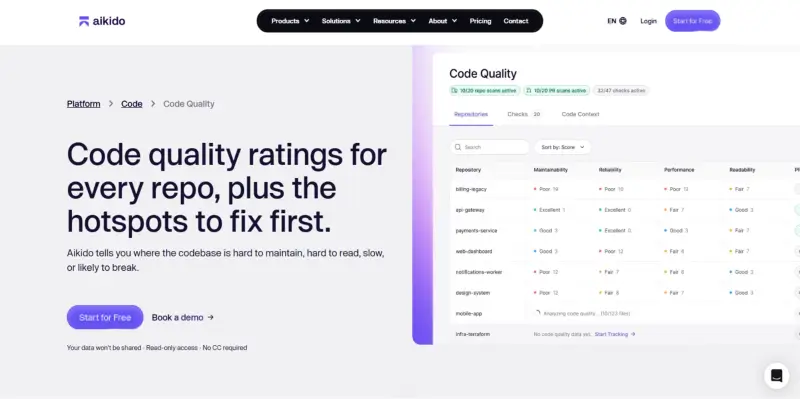
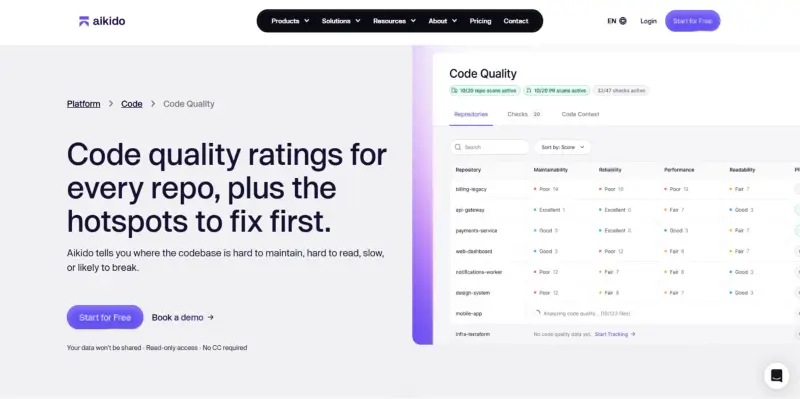
Aikido combines a developer security platform with code quality tools. Its Code Quality product scores repositories; Deep PR Review is a separate product that examines pull requests using context from the full repository.
Code Quality gives each repository a score covering reliability, performance, readability and maintainability. It identifies hotspots: files that change frequently and continue to accumulate findings. Teams can enable pull request checks to review changed lines and post comments inline, scan whole repositories, or use both approaches.
Checks cover issues such as logic errors, incorrect conditions, null or undefined dereferences and runtime errors. Findings include plain language explanations and fix guidance. AutoFix can prepare a change for each finding for a developer to review. A threshold can also be set for automatic fixes. Teams can apply ready made rule templates or define their own rules and style guides for pull requests.
Aikido tracks test coverage when teams upload it from their CI pipeline. Coverage appears alongside other quality data on Basic, Pro, Advanced and Enterprise plans; it isn’t included in Developer. Deep PR Review must be enabled separately for each repository. It uses multiple AI agents to read the repository rather than only the diff, with each review costing one credit per pull request. Aikido supports GitHub, GitLab, Bitbucket and Azure DevOps, and Code Quality isn’t limited to one programming language.
Codacy
Codacy combines code quality and security checks with an AI Reviewer for pull requests. The company says more than 15,000 organizations use its products. The AI Reviewer is opt in, GitHub only, and included with Team and Business plans; an administrator must enable it.
Its approach combines consistent, rule based checks with AI that considers context. The reviewer can flag critical functions without unit tests, identify functions that have become too complex and suggest simplifications. It can also compare a pull request description with the code and point out promised logic that appears to be missing.
Codacy sends three status checks to the Git provider, giving teams pass or fail indicators on pull requests. Guardrails can turn team written coding and security policies into automated checks for AI coding agents. The status checks work with GitHub, GitLab and Bitbucket.
SonarQube
SonarQube is available as managed SonarQube Cloud or self managed SonarQube Server. Sonar says more than 7 million developers use the product. Its static analysis examines code without running it, looking for maintainability concerns, duplicated code, security issues and bugs.
Analysis can start when code is committed or pushed. The free Community Build checks the main branch only. SonarQube Cloud Free covers the main branch and pull requests targeting it. Quality gates compare changes with thresholds set by the team and return a pass or fail result, supporting a decision about whether code is ready to merge or release.
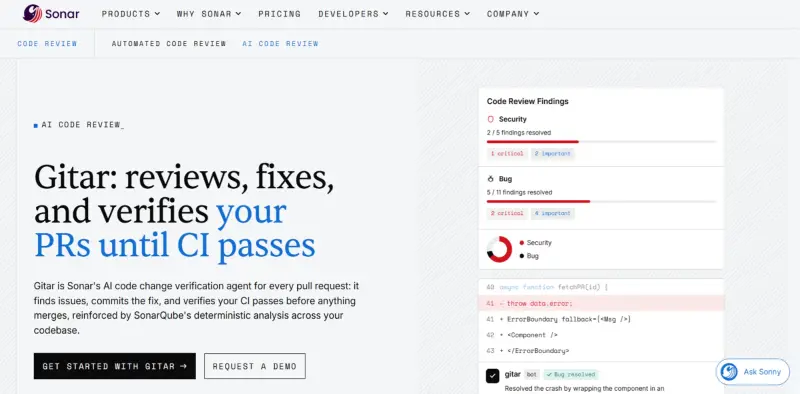
AI CodeFix uses a large language model to suggest a fix for an identified problem. It’s listed for SonarQube Cloud Team and Enterprise, and SonarQube Server Enterprise and Data Center. Sonar also offers Gitar as a separate product: an AI agent that reviews pull requests, commits fixes and checks that CI passes before merge. SonarQube supports GitHub, Bitbucket Cloud, GitLab and Azure DevOps.
CodeRabbit
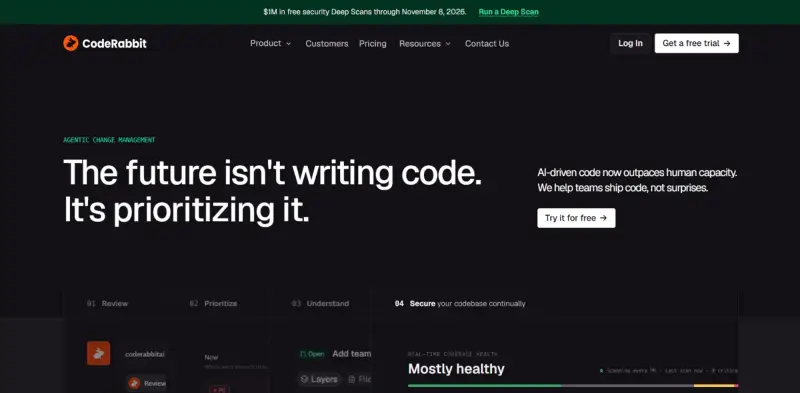
CodeRabbit automatically reviews pull requests and provides triage and a pull request interface for larger changes. The company says 17K customers trust the platform. Review comments work as chats: developers can mention @coderabbitai in a reply to ask for an explanation, request code examples or discuss alternatives.
Teams can set pre merge checks and post merge actions. Its Triage feature scores, ranks and routes pull requests, with a queue that can cover multiple repositories. The feature is marked new. For large changes, Change Stack explains the significance of the change, while Quiet, Chill and Assertive profiles let teams adjust the review’s tone. CodeRabbit supports GitHub, GitLab, Azure DevOps and Bitbucket.
Greptile
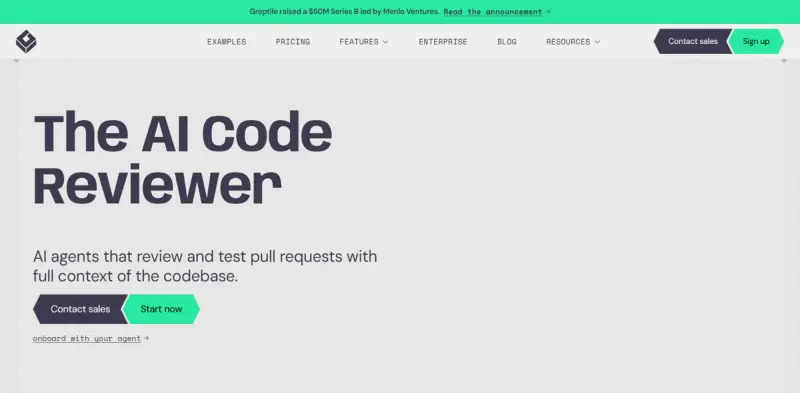
Greptile uses AI agents to review and test pull requests with context from the codebase. It builds a repository map connecting files and functions to their dependencies. The Pro plan also includes cross repository context, and its agents assess how a change could affect code outside the diff.
TREX, marked beta, runs a pull request branch in a sandbox to look for problems that appear at runtime. Developers can send issue context to Claude Code, Cursor, Codex or Devin with one click. Enterprise customers can run Greptile on their own infrastructure, on premises or in their cloud, using Docker Compose or Kubernetes and their chosen language model providers. Listed integrations include GitHub, GitLab, Bitbucket and Cursor Origin; Enterprise adds more.
Qodo
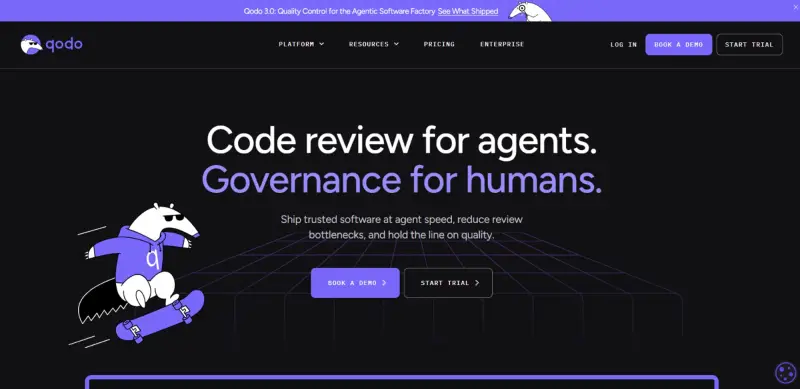
Qodo positions its platform across IDEs and Git pull requests, with code review and governance features. Its FAQ says teams report saving about an hour on every pull request. Specialized agents review each change using whole codebase context, looking for bugs, rule violations and gaps against requirements.
Cross Repo Review examines related repositories. If a change to a shared library function could affect dependent code, Qodo can flag the issue on the pull request and link to the affected line. Rules Miner turns recurring review comments and reviewer decisions into rules teams can enforce. Risk intelligence tracks findings, resolution rates and risk concentration across teams and repositories.
Enterprise plans support on premises or single tenant deployment. Qodo works with GitHub, including Enterprise Server; GitLab, including self managed; Bitbucket Cloud and Data Center; and Azure DevOps. Gerrit support is available on Enterprise.
GitHub Copilot code review
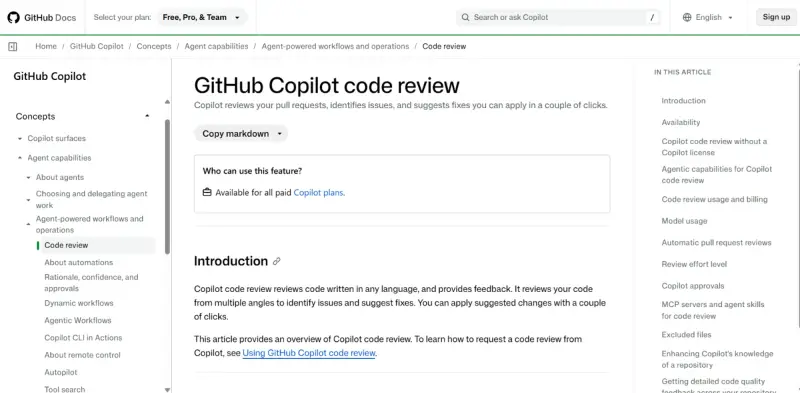
GitHub Copilot code review brings an AI reviewer into GitHub and requires a paid Copilot plan. It reviews code in any language and suggests fixes that developers can apply in a couple of clicks.
In public preview, an overview comment assesses whether a pull request appears ready for approval. Copilot reviews don’t count toward required approvals by default. Also in public preview, reviewers can pass suggestions to the Copilot cloud agent, which opens a new pull request against the branch with the fixes applied.
The reviewer follows custom and agent instructions, as well as agent skills, from the head branch. That lets teams try instruction changes within the same pull request. GitHub Code Quality is a separate feature requiring GitHub Team or GitHub Enterprise Cloud. It provides AI powered analysis of recently changed files on the default branch; pull requests show only rules based findings from CodeQL. Copilot code review works with GitHub.com, GitHub CLI, GitHub Mobile and several IDEs. Azure DevOps support remains in public preview.
Trial against real changes
For quality scores and merge thresholds, Codacy or SonarQube may fit; Aikido also combines repository scoring with pull request checks. Teams trying to catch ripple effects across dependent code can compare Aikido Deep PR Review, Greptile and Qodo. The right shortlist depends on repository hosting, plan eligibility and where developers will act on findings. Test the candidates on real pull requests, then check whether their comments, fixes and status checks fit the team’s review process.


