- Subject
- Microsoft 365 & SharePoint
- Filed
- Source
- Al Iverson
- Loans
- 998
Microsoft Email Outage Eases After Outlook.com and Microsoft 365 Delivery Delays
Webmail access and inbound delivery were disrupted across Microsoft mail services on November 12. By November 13, providers reported recovery, though Microsoft still showed degraded service.

Microsoft’s November 12 email disruption affected both mailbox access and inbound delivery across consumer and business services. By the morning of November 13, external mail providers described the problem as resolved or mostly resolved, while Microsoft’s service dashboard continued to show degraded service. For administrators, that gap matters: successful access does not necessarily mean delayed messages have all been accepted, processed and delivered.
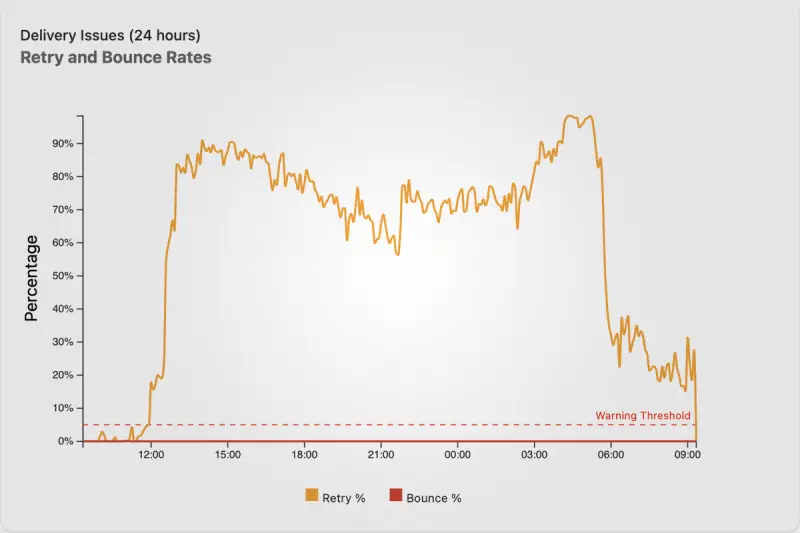
The impact covered Outlook.com and Hotmail for consumers, as well as Microsoft 365 for business users. People reported being unable to access webmail, while senders trying to reach Microsoft-hosted mailboxes experienced delayed delivery. The first significant problems were reported between 10:30 a.m. and 12:30 p.m. US Central time on Thursday, November 12. The incident timing varied by service and reporting source: SparkPost said Microsoft mail servers had been returning temporary errors since about 17:30 UTC that day.
Temporary errors slowed delivery
SparkPost, also known as Bird Email, said a large share of delivery attempts to Microsoft mailboxes were receiving temporary errors. Its incident notice named Outlook.com, Hotmail, Live, MSN and Office 365 as affected destinations. The reported responses included “451 4.7.0 Temporary server error,” “421 4.3.2 The maximum number of concurrent server connections has exceeded a limit” and “451 4.7.700 PFA agent busy.”
These responses indicate that delivery attempts were being deferred or refused temporarily, rather than confirming that a message had reached its recipient. For mail administrators and service operators, that distinction affects what to check: a sender may still be retrying delivery, and a message can remain delayed after the receiving service begins recovering. The incident reports described temporary failures, but did not give a final count of affected messages or a guaranteed time for every delayed message to arrive.
Groups.io’s email provider dashboard showed a rise in reported delivery problems over the preceding 24 hours. That view offered an external indication of the disruption, while SparkPost’s incident notice described the errors observed by its delivery systems. Microsoft tracked the issue on its service status dashboard as incident EX1550543.
Microsoft traced the problem to connection handling
In a Thursday update, Microsoft said its investigation had identified a process on affected servers that establishes secure connections. The process had become overwhelmed, according to the company, causing those servers to stop processing requests. Microsoft said it was preparing a configuration change for affected servers and validating that change on a subset before applying it more widely. The plan also included restarting affected infrastructure.
Microsoft was pursuing a second mitigation at the same time: reverting a recent network configuration change that correlated with the start of the impact. The company said it was monitoring whether the rollback contributed to recovery. It also reported that temporary traffic limits were in effect in specific locations. Microsoft planned to monitor stability under the narrower connection load, then gradually restore additional traffic.
That sequence points to a staged recovery rather than a single switch being flipped. Testing the configuration change on some servers before broad deployment gives Microsoft a way to check whether the adjustment helps under live conditions. Traffic limits and gradual reintroduction can also reduce the load on infrastructure while it is being assessed. The updates did not specify how long each step would take or when every affected location would return to normal operation.
Recovery reports did not settle the backlog question
At 9:15 a.m. on Friday, November 13, SparkPost and other providers were reporting the issue as resolved or mostly resolved. Microsoft’s dashboard still indicated degraded service. Some users reported that messages they had been waiting for began arriving overnight, at different times.
That is consistent with a service returning gradually: new delivery attempts may begin succeeding while messages delayed during the disruption are still making their way through processing and delivery. It remains an interpretation of the available reports, rather than a confirmed Microsoft estimate of a backlog. The updates gave no total queue size or completion time.
For IT teams, the practical check is whether users can access their mail and whether delayed inbound messages are arriving. If delivery remains uneven, the temporary error responses reported by SparkPost provide useful context when reviewing sender-side delivery logs. Microsoft’s incident ID, EX1550543, and its service status page are the relevant references for tracking the company’s reported service condition.
By Friday morning, the reports pointed to broad recovery, but Microsoft had not yet cleared the degraded status shown on its dashboard. Teams handling time-sensitive mail should continue checking delivery and service status until both access and message flow have returned to their expected pattern.