- Subject
- Microsoft 365 & SharePoint
- Filed
- Source
- IPWITHEASE
- Loans
- 919
Data Center Temperature Monitoring: Comparing Five Approaches
Compare five data center monitoring platforms by sensor coverage, integrations and fit, then match sensing methods to the risks your team needs to track.
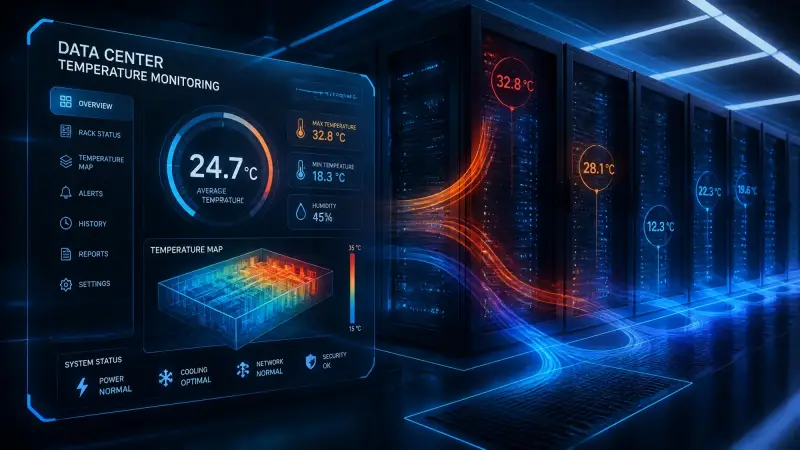
Temperature monitoring choices come down to coverage. Rack probes report conditions where they’re installed, while software gathers readings from connected devices and helps teams act on alarms. Area sensing can extend visibility across equipment and zones, including parts of the power path that rack sensors may miss.
That coverage gap matters because power problems account for 45 percent of impactful data center outages, according to the Uptime Institute. The source cites annual infrared inspection of electrical connections as the industry standard under NETA; that interval can leave as many as 364 days between checks. Continuous monitoring can add visibility between inspections, though it serves a different role from close-up thermography.
Match the sensing method to the coverage gap
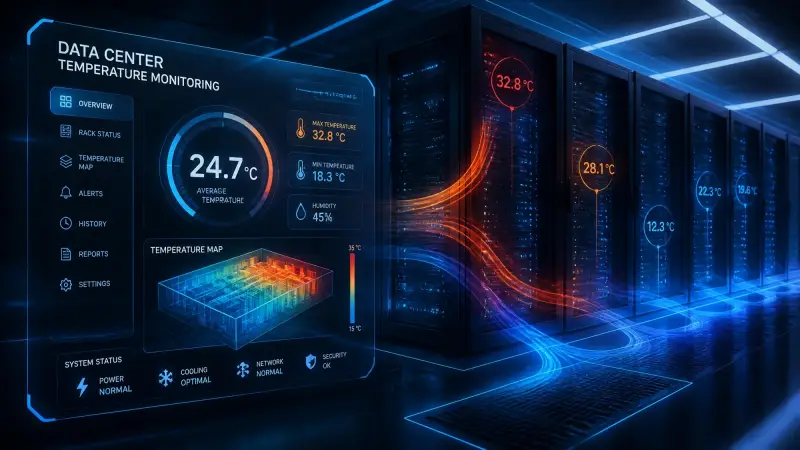
Point sensors measure a specific location, such as a rack inlet or busway lug. Linear sensing, including fiber optic distributed temperature sensing, tracks temperature along a cable or busway. Area sensing measures across a zone or piece of equipment. Monitoring software collects readings from connected sensors and devices, then presents alarms, trends and facility views.
The five options below take different routes. Schneider Electric, Vertiv and Eaton pair point sensors with broader management software. Butlr uses thermal arrays for zone coverage. Sunbird aggregates readings from third-party equipment through its DCIM software. The practical choice depends on what’s already installed, where the blind spots are, and which systems need to receive alerts.
Schneider Electric: NetBotz and EcoStruxure IT
NetBotz appliances collect readings from wired and wireless rack sensors. EcoStruxure IT Expert, Schneider Electric’s cloud based DCIM software, brings those readings together with alarms from power and cooling equipment across one or more sites.
- Sensor capacity: A NetBotz 250 supports up to 47 wireless and 42 wired sensors for temperature, humidity, spot fluid and smoke.
- Wireless deployment: Sensors join the network automatically and run for three to five years on a battery, allowing added coverage in an operating hall without new cable runs.
- Mixed equipment: EcoStruxure IT Expert monitors devices from other manufacturers as well as Schneider Electric and APC equipment.
- Alerts: Analytics use live and historical device data to flag anomalies and rank alarms, with notifications by email and the EcoStruxure IT mobile app.
Each sensor still reads one location, and rack probes don’t report temperatures at busway joints or panel lugs. The full setup spans several products, including NetBotz appliances, Data Center Expert and IT Expert, so teams need to scope the combination they require. It fits enterprises and colocation providers with mixed equipment, especially those already using APC UPS and rack infrastructure.
Vertiv: Geist Watchdog and Environet Alert
Geist Watchdog monitors combine onboard temperature, humidity and dew point sensors with ports for external probes. Vertiv’s Environet Alert software gathers readings from monitors and other devices into a multi site view.
- Expandable sensing: The Watchdog 100 includes temperature, humidity and dew point sensors and accepts up to eight additional external sensors.
- PDU probes: Temperature sensors can connect to Vertiv rack PDUs, adding rack readings without a separate appliance.
- Alert options: Readings are available through a secure web interface. The Watchdog 100 supports email, SNMP and email to SMS alerts, with up to 50 customizable alarms and escalation settings.
- Integration: Environet Alert monitors Vertiv and non Vertiv SNMP devices and connects with other business systems through an API.
Probe placement determines what the system sees. Vertiv recommends sensors at the top, middle and bottom of racks, along with cooling intake and discharge vents. Environet Alert is aimed at teams that don’t need a full DCIM suite; larger operators may need additional Vertiv software for capacity planning. The platform also leaves electrical connection temperatures along the power path outside its coverage. It suits server rooms, edge sites and halls already using Vertiv power and cooling.
Eaton: Brightlayer Data Centers Suite
Eaton combines asset management, IT and OT device monitoring, power quality data and electrical supervision in Brightlayer Data Centers. At rack level, an Environmental Monitoring Probe (EMP) Gen 2 supplies temperature and humidity readings through compatible Eaton UPSs and PDUs.
- Power and environment: The suite brings power use, asset locations and environmental conditions together, helping operators trace a thermal alarm through the power chain.
- Facility views: Users can build 2D and 3D digital twin views for temperature and humidity mapping alongside electrical utilization and power chain status.
- Probe data: Each EMP Gen 2 provides one temperature point, one humidity point and two dry contact data points, readable over SNMP or a web browser.
- Connections to other tools: Built in integrations include ServiceNow for incident reporting and RF Code for environmental sensor management.
The suite consists of separate products for performance management, electrical power monitoring and distributed IT, so buyers need to identify the components they need. EMP probes read a single rack location and connect through compatible Eaton equipment; the resulting temperature view is limited to connected sensors. Brightlayer is a fit for operators who want electrical and environmental monitoring together, particularly those running Eaton UPS and power distribution equipment.
Butlr: thermal arrays for zone coverage
Butlr focuses on conditions around servers, including the power path, liquid cooling and the hall. Its low resolution thermal sensor arrays monitor zones, then combine readings with server management chip data in a live thermal digital twin organized by hall, rack and rack unit.
- Power path: Sensors continuously monitor remote power panels, busway tap offs, power whips, rack PDUs and busbar joints. The system is designed to detect electrical faults before they escalate.
- Server and temperature data: Operators can view server telemetry alongside thermal readings to see where compute load and heat coincide.
- Liquid cooling: Coolant monitoring runs on the same platform as electrical and white space monitoring.
- Cooling design checks: Before a hall goes live, teams can compare measured cooling performance with CFD airflow models.
Area thermal sensing has fewer long running reference deployments than probes or handheld thermography. Facilities that document conditions against ASHRAE inlet ranges still need air sensors for that work. The thermal sensors are camera free; live 360 video is an optional add on, and the thermal system can operate without imaging hardware. Butlr is aimed at AI and neocloud operators seeking continuous visibility around high value GPU infrastructure.
Sunbird: Power IQ and dcTrack
Sunbird’s Power IQ gathers power and environmental readings from rack PDUs and sensors made by multiple manufacturers. dcTrack adds asset, capacity and change management. Power IQ supports leading vendors’ environmental sensors, intelligent rack PDUs and monitoring aggregators.
- Sensor range: Alongside temperature and humidity, the software analyzes leak detection, smoke, air pressure, airflow and contact closure data.
- Psychrometric chart: A patented electronic chart plots temperature and humidity readings in real time, giving teams a combined view of sensor data.
- Trends and retention: Baselines and long term charts can help identify gradual changes; administrators set how long data is retained.
Sunbird doesn’t make sensors, so coverage depends on the probes and PDUs already installed. Power IQ and dcTrack are separate products, and locations without sensors, such as busway joints or the space between rack rows, won’t appear in dashboards. It fits teams with mixed hardware that want a shared view of power and environmental readings across sites.
Plan for overlapping coverage
Continuous monitoring can help teams spot changes between infrared inspections, but annual inspections may still be needed. Handheld thermography provides a close up view for investigating suspected faults and documenting conditions for maintenance programs; it complements sensors that report continuously.
DCIM software also depends on a sensing layer. Sensors produce the readings; the platform can bring them together, apply thresholds, raise alarms and provide a view across sites. Wireless sensors are used in data halls, but teams should check that monitoring traffic is separated from the production data network, readings are encrypted and the system integrates with their DCIM or building management system.
Start with the failure mode that would have the greatest operational impact. If electrical connections and the power path are the main concern, investigate area or linear sensing for those assets. If the priority is documenting rack inlet temperatures, point probes offer a direct starting point. Most facilities will need to combine methods as their coverage requirements grow.