- Subject
- Windows & PowerShell
- Filed
- Source
- David Vellante, Amit Eyal Govrin and John Furrier
- Loans
- 839
Sovereign AI Architecture: Test Data Boundaries, Access and Exit Plans
A small buyer study finds sovereignty concerns outpacing operational tests, while model location, support access and exit costs shape AI deployment decisions.
AI sovereignty is an architecture decision with operational and financial consequences. For organizations using cloud and frontier AI services across borders, the key questions reach beyond where data is stored: who can access it, which model processes it, who operates the system, and what happens if the customer needs to leave.
A study of eleven senior technology decision-makers in regulated and critical-infrastructure organizations points to a gap between concern and evidence. Seven respondents had not tested disconnected operation, key revocation or exit scenarios. Only four had deployed or piloted a distinct sovereign or dedicated offering. Cost and the work of adding another environment were the main reasons buyers relied instead on controls layered onto platforms they already used.
That gap matters because sovereignty claims are only useful if teams can show how a system behaves under pressure. Legal review can help establish who may have access; operational testing can reveal what stops working when access is removed. Both are needed, and one cannot stand in for the other.
Support access belongs in the architecture review
One European IT and telecom buyer said that deep technical support escalations can, in some cases, involve personnel or systems outside the EU. That possibility makes support procedures part of the system design: buyers need to understand emergency access, privileged access and the routes support teams can use.
This does not make every cross-border support path unacceptable. It means the organization should identify the exposure, decide whether it can accept it and apply compensating controls where needed. Sovereignty is a set of risk decisions, not a purity test. A team may accept an exception during an emergency, provided the condition and its consequences are understood.
Some customers are waiting for clearer local requirements before expanding their sovereignty testing. For now, they are relying on existing privacy and cybersecurity practices. That uncertainty is a reason to define acceptance tests early: teams need evidence about their own workloads even while external expectations are still taking shape.
Local inference can limit model choice
Nine of the eleven respondents said inference must occur inside a sovereign or regional boundary. Buyers also reported that model availability can lag in those environments. The architectural choice may therefore involve a tradeoff between jurisdictional exposure and model capability for a particular workload.
The request path needs close inspection. A prompt may pass through retrieval services, model endpoints, output handling and logging systems; an application that appears to stay within an approved boundary can still call another service during execution. Buyers need to trace where data goes throughout that cycle, including during use, rather than relying only on storage location or contract language.
A Latin American financial-services buyer put the boundary requirement plainly: “If it calls out to a U.S. endpoint, it doesn’t count no matter what the contract says.” For sensitive workflows, buyers can compare a self-hosted open-weight model with an approved frontier service, assessing the cost and quality of each option. Open weights can give teams more control over deployment, while a frontier service may deliver results that justify a different level of exposure. The decision depends on business value and the risk the organization is prepared to carry.
Cost shapes how far buyers go. Migration work, staff retraining and the expense of leaving a service all affect the scope of sovereignty investments. Many organizations apply stronger controls to sensitive workloads and accept more exposure for lower-risk activity. That makes workload-level assessment more useful than treating an entire cloud estate as having one uniform sovereignty requirement.
Vendor scores are a starting point
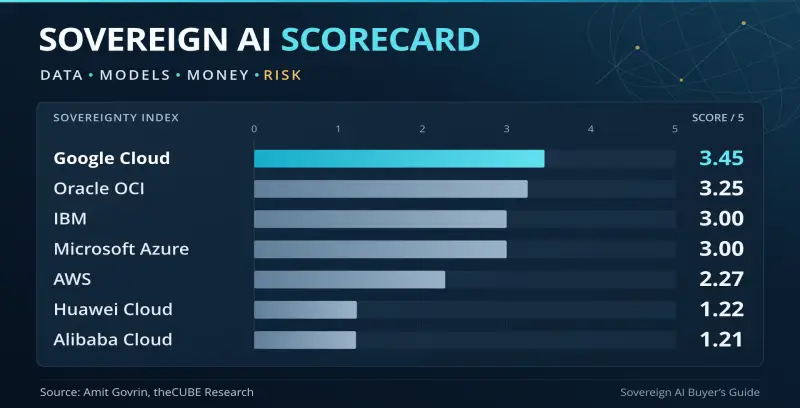
A buyer’s guide measuring vendors’ documented controls reported the following overall scores in its Nov. 14 revision: Google LLC, 3.45; Oracle Corp., 3.25; IBM Corp. and Microsoft Corp.’s Azure, 3.0; AWS, 2.7; and Huawei Technologies Co. Ltd. and Alibaba Group Holding Ltd., 1.2.
The index averages each supplier’s best live offering across five buyer regions. Its framework covers territorial, legal, operational, technical and financial pillars, with 17 yes-or-no tests across four nonlegal dimensions and a separate legal evaluation. The results are a point-in-time comparison of documented claims, not a decision rule for every workload.
A lower score does not rule out a vendor. The assessment found buyers choosing AWS in some cases because of its service quality and incumbent position, and choosing Azure because it was already a widely used, convenient cloud. Similar considerations apply within IBM and Oracle customer bases. The guide also found that customer-run deployments generally score better under a method that rewards controls buyers can exercise independently. Missing documentation affects grades too.
Teams can use the comparison to frame an evaluation, then check the specific service available in their jurisdiction against workload needs and local requirements. AWS’s score, for example, was affected by the lack of an option for a customer-run air-gapped stack without vendor management. The practical significance of that gap depends on the buyer’s need for independent operation and the available alternatives.
Keys and corporate control need separate checks
Seven respondents said that a locally incorporated subsidiary does not, by itself, settle questions about which jurisdiction may apply. The study reflects buyer assessments, and its finding points to the need for deeper legal analysis alongside technical review.
Under the U.S. CLOUD Act, a vendor subject to U.S. jurisdiction can be required to produce data in its possession or control regardless of where that data is stored. Corporate relationships and actual control therefore matter. Customer-held encryption keys may limit outside access, but holding the keys does not necessarily provide legal immunity. Buyers also need to test what happens to the workload if a key is revoked.
A South American bank’s executive director for AI described the lack of testing as “probably the weakest point in our whole sovereign story.” That concern captures a practical weakness: teams may have a legal position without knowing whether their systems can operate, recover or exit as intended.
Reassess when the system changes
Sovereignty needs ongoing review because AI systems and their dependencies change. A model endpoint can move, a new model can ship, a contract can change or another service can enter the execution path. Each change may alter who can access data, where processing occurs or how much it costs to operate and leave.
A five-pillar assessment can bring vendor capabilities and claims together with the customer’s actual architecture. For each workload, the useful questions are concrete: What is exposed? Who has control? Who owns the decision? What risk is the business accepting? Major changes to models, services or contracts should trigger a reassessment that combines vendor documentation with technical tests.
For critical workloads, teams should agree on required controls, test them in a safe sandbox and gather evidence before production deployment. Tests should cover privileged access, key revocation, recovery, disconnected operation and exit. Telemetry should show the route a request takes and what the model did; the study identifies limited observability and testing as gaps for many customers.
The financial review should account for ongoing operation, migration, retraining, exit costs and business disruption. A business owner needs to accept the workload’s residual risk, since the consequences extend beyond IT operations. Vendors, in turn, can help buyers by documenting controls, explaining operating costs and providing evidence that supports their claims.
The practical starting point is one core business process. Map its data and service dependencies, set controls according to its sensitivity, then test whether those controls hold under the conditions the organization says it can tolerate. That evidence will give the next model, endpoint or contract change a clear trigger for review.