- Subject
- Microsoft 365 & SharePoint
- Filed
- Source
- Vlad Catrinescu
- Loans
- 573
Copilot in SharePoint: Licensing, Agent Migration and Autofill Admin Guide
Copilot in SharePoint requires a per-user license, with credits for advanced work. Admins should review site controls and migrate classic agents by March 2027.
Copilot in SharePoint brings everyday AI tasks under a per-user Microsoft Copilot license, while advanced processing draws on Copilot Credits. For administrators, the near-term work is to understand that cost split, review which sites can use Copilot, and plan for classic SharePoint agents to stop working after March 2027.
General availability began rolling out on September 30, 2026, but tenants may see the feature later as the rollout progresses. A Copilot in SharePoint button appears in the lower-right corner of SharePoint pages and document libraries when it reaches a tenant. Every user who uses the feature needs a Microsoft Copilot license, formerly Microsoft 365 Copilot. The license includes everyday capabilities without an additional opt-in step; credits pay for specified advanced work on top of that license.
The main operational changes are tied to dates. Preview PowerShell settings that limit Copilot in SharePoint are honored only until November 1, 2026. New agents for SharePoint move to Microsoft Copilot Agent Builder starting in mid-November 2026, while classic .agent files stop responding after March 2027. Teams that relied on preview settings or have a library of classic agents should review both before those deadlines arrive.
Availability, licensing and site controls
There is no pay-as-you-go route to use Copilot in SharePoint without a Copilot license. SharePoint agents pay-as-you-go applies to classic .agent files, and Microsoft’s upgrade guidance says it does not apply to Copilot in SharePoint. As classic agents retire, unlicensed use of agents moves to Copilot app pay-as-you-go. That distinction matters when planning access: credits and pay-as-you-go do not replace the per-user Copilot license for Copilot in SharePoint itself.
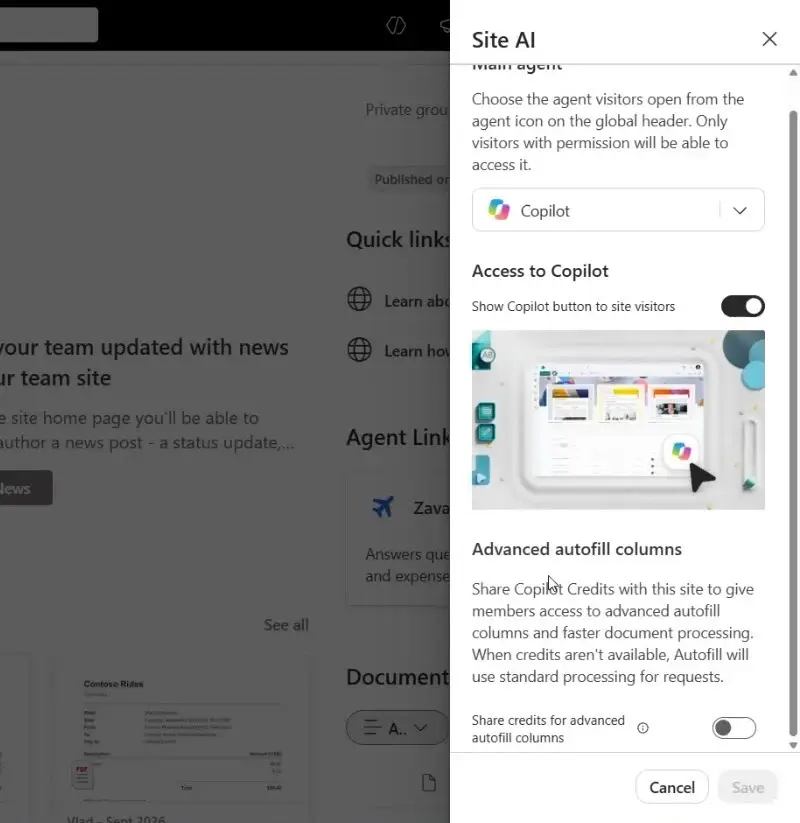
For autofill columns configured with Copilot in SharePoint, new files are covered by the Copilot license even if the library is connected to a pay-as-you-go meter. Advanced autofill processing, including real-time processing as new content arrives, uses Copilot Credits when an administrator enables it.
Copilot in SharePoint is not currently available in GCC, GCC High, DoD, Office 365 air-gapped cloud environments or Microsoft 365 operated by 21Vianet. Message Center post MC1511052 says availability is coming to government clouds, but gives no date. Usage-based billing through Copilot Credits is also unavailable in GCC and GCC High. Microsoft says the agent transition applies to its government clouds and that Agent Builder upgrades are supported there; Agent Builder is not currently available for declarative agents in DoD. Converting an agent to a skill must wait until Copilot in SharePoint is available in those environments.
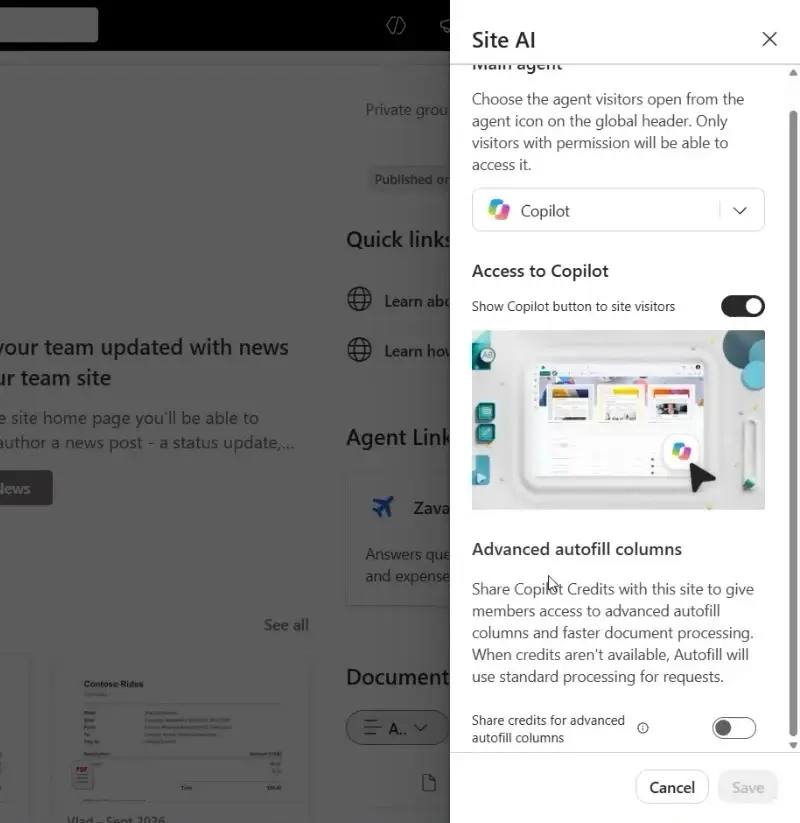
Site AI is the site settings panel for decisions about AI use, including which agent opens from the agent icon in the site header. Site owners reach it through Settings > Site AI. They can choose Copilot in SharePoint or a custom agent as the main agent, hide the Copilot button from site visitors, and enable advanced document processing by sharing a site admin’s Copilot Credits for autofill across the site.
Hiding the button affects visitors only; it does not fully remove Copilot in SharePoint from a site. Restricted Content Discovery is the control that keeps Copilot in SharePoint and AI actions off the site. The main-agent setting also has a deadline: after March 2027, Copilot will be the only main agent available for a site and Microsoft will remove that setting.
What the license covers and when credits apply
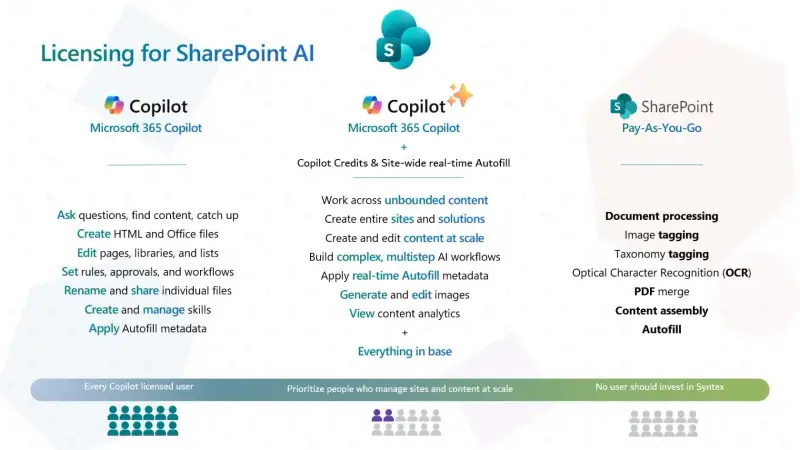
Creating and managing skills is included with the Copilot license. The cost depends on what a skill does when it runs, not simply on the fact that someone created it. Microsoft describes its licensing as a hybrid model: routine work is included, while advanced work uses Copilot Credits through usage-based billing.
Everyday work covered by the license includes asking questions, finding content and catching up; creating HTML, Word, Excel and PowerPoint files; creating and editing pages, libraries and lists; simple rules, approvals and deterministic workflows; renaming and sharing individual files; creating and managing skills; and using autofill metadata.
Credits apply to work that spans large or unbounded content sets, creates entire sites or solutions, or creates and edits files, pages, libraries and lists at scale. They also apply to complex multistep AI workflows, such as skills in scheduled AI automations; real-time autofill metadata; generating images or editing existing ones; and analytics on site, page, news and document performance.
Microsoft’s rule of thumb is that credits apply when a task “spans more content than you can work through yourself, needs to run on its own, or has to keep pace as content arrives.” Its Copilot Credits Guide uses 10,000 files as a heavy-work example and a 500-file project-folder retagging task as a medium example. Microsoft does not publish a universal file-count threshold for work “at scale.” When a prompt crosses the threshold, Copilot asks the user to approve credit use before continuing. Without credits, Copilot completes what it can and asks the user to start a new chat.
Administrators enable advanced work in the Microsoft 365 admin center under Copilot > Cost management. They create a spending policy, assign it to all users or selected security groups, select Advanced work in SharePoint under Agents and services, and set a spending limit, alerts and billing method. Existing policies deserve a review: a policy that automatically permits new agents and services as they become available may already include Advanced work in SharePoint.
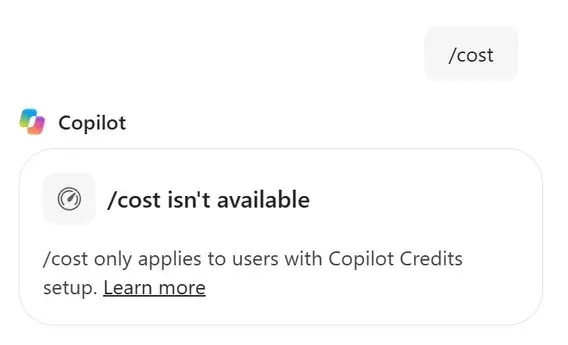
Until a spending policy covers a user, that user gets everyday work only. The /cost command, which reports credits used for a task, is not available to users without Copilot Credits set up. Microsoft’s guidance prioritizes content managers and site managers for credits; most other SharePoint users likely do not need them. A practical rollout can therefore license users for everyday features, then assign credits to the smaller group responsible for content work at scale.
Nothing Microsoft has published says the prebuilt SharePoint page and list agents need credits, so their requirement is the Copilot license. The SharePoint list agent left the Frontier program and became generally available in February 2026; it requires a Copilot license. The SharePoint page agent, which was a Frontier preview, is being retired between mid-October and mid-November 2026, according to Message Center post MC1481325. A notice about that change was sent on September 29, 2026.
Users can continue creating and refining pages and news posts with Copilot in SharePoint. Creating and editing pages, libraries and lists is included in the license; doing this work at scale is where credits apply. Microsoft has not announced that Syntex is being deprecated. Its pay-as-you-go services remain available as document processing for Microsoft 365.
Who can use agents, and what testing costs
People using an agent need a Copilot license or an administrator-configured pay-as-you-go option. Copilot-licensed users can interact with agents grounded in organizational content at no extra cost. For unlicensed users, the billing route depends on how the agent was built.
- Classic SharePoint agents saved as .agent files use SharePoint agents pay-as-you-go. An administrator creates a billing policy and assigns it to a security group; only members of that group can use the agents. Microsoft lists the price as $0.01 per message, and a successful interaction uses 12 messages.
- Agent Builder agents that use SharePoint content are billed through pay-as-you-go as Copilot Credits. For Microsoft Copilot Chat users without a Copilot license, these agents are off by default.
After .agent files retire, Microsoft consolidates unlicensed agent use under Copilot app pay-as-you-go. For SharePoint content, users need permission to both the agent and its content. An agent should not expose a SharePoint file to someone who cannot open it directly. One exception is content a maker uploads into an Agent Builder agent: anyone who can use the agent can receive answers based on those uploaded files.
A Copilot-licensed user can test an agent in the preview pane without extra credit charges, because interactive use of agents is included. Microsoft does not document whether testing in SharePoint’s preview pane or Agent Builder’s Try it tab is metered when the maker uses pay-as-you-go without a license. In that case, it is prudent to treat a test that reads SharePoint content like other agent use that may be billed.
Microsoft documents a separate rule for Copilot Studio: activity by the agent in its test chat does not consume credits. AI prompts or models inside agent flows, and agents built on the GitHub Copilot harness, are exceptions and bill during testing.
Moving classic agents to Agent Builder
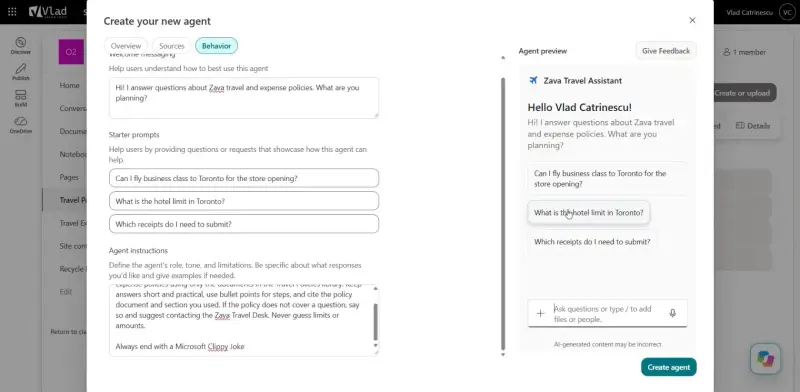
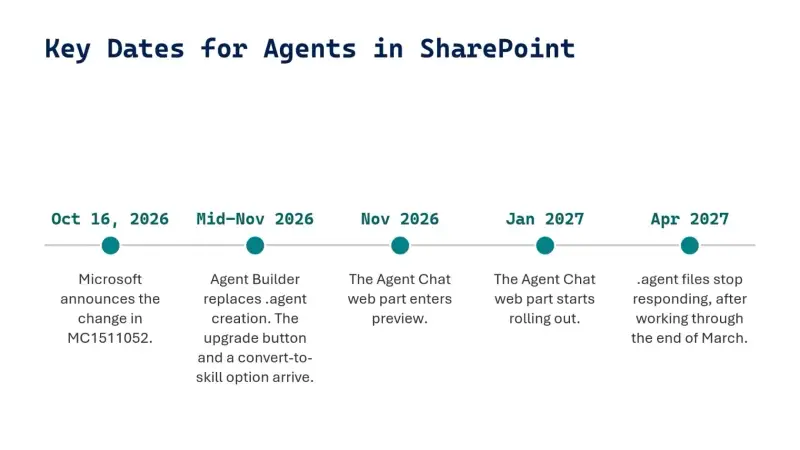
Classic SharePoint agents are declarative agents saved as .agent files on a site. Starting in mid-November 2026, Microsoft says new agents for SharePoint and OneDrive will be created with Microsoft Copilot Agent Builder and will no longer be saved as .agent files. Makers can still choose SharePoint and OneDrive content as knowledge sources; Agent Builder also supports sources such as Teams chats and meetings, Outlook email and Copilot connectors.
The transition is not automatic. Microsoft’s timeline gives organizations until the end of March 2027 before .agent files stop responding in SharePoint, Teams and the Copilot app. From mid-November 2026, an “Upgrade to Microsoft 365 agent” button appears in the builder, and the convert-agent-file-to-skill skill becomes available in Copilot in SharePoint. The Agent Chat web part, which places an agent chat on a SharePoint page, begins preview in November 2026, with general availability planned for January 2027 on the Microsoft 365 roadmap.
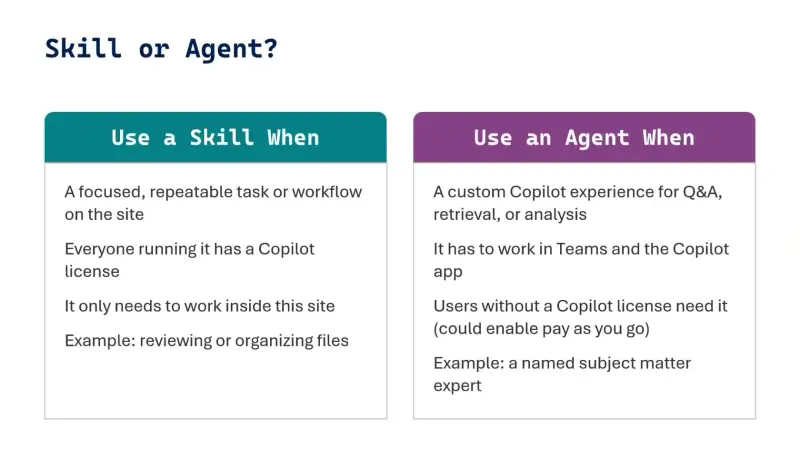
Choose the replacement based on the agent’s job. Copilot in SharePoint can replace an agent that mainly answers questions about its own site. A repeatable process is a candidate for a skill. A named question-and-answer or retrieval experience can move to Agent Builder.
Permissions and history need attention during migration. An Agent Builder agent is shared separately rather than inheriting SharePoint file permissions. Unless the original agent was shared with everyone in the organization, the upgraded agent starts private to its maker. The .agent file’s usage history does not transfer, so teams should identify intended users and re-establish sharing after conversion.
If an agent has disappeared from a site’s navigation, it may still be working: classic .agent files remain active until the end of March 2027. The agent icon may now open Copilot in SharePoint instead of the ready-made site agent. Unless a site owner selects a custom main agent in Site AI settings, Copilot is the site’s main agent for Copilot-licensed users. Restricted Content Discovery also removes the agent icon. An unlicensed user may not see it if the organization has not set up agent pay-as-you-go. In the Copilot app, Microsoft is replacing the Agents entry point with Plugins, and upgraded agents appear in the plugin store.
Agent Builder agents currently do not use or require app registration IDs or Microsoft Entra Agent IDs. The agent identity documentation does not mention an identity for classic SharePoint agents either; their answers depend on each user’s permissions to the sources. New agents created in Copilot Studio receive a Microsoft Entra Agent ID automatically.
Administrators can inspect agents in the Microsoft 365 admin center at Agents > All agents > Registry. The registry includes agents with and without a Microsoft Entra agent identity, lists SharePoint as an agent type, and provides an overview of classic agents used in Copilot Chat. Blocking a classic agent in the registry affects its availability in Copilot Chat only.
Agent Builder agents, including the agents created for SharePoint from mid-November 2026, integrate with Microsoft Agent 365 automatically. Viewing the registry does not require a specific license. Agent 365 observability and policy features require Microsoft 365 E7 or an Agent 365 license.
Grounding agents in approved content
SharePoint permissions and version visibility shape the answers people receive. A reader who can view a library but cannot access drafts gets the last approved major version of a document. SharePoint search does not return files that exist only as minor versions, so an agent serving a visitor with access only to published content can answer from the published version.
Check the library’s Draft Item Security setting. If it is set to “Any user who can read items,” readers can see drafts, including the account used to crawl content for search. Editors and approvers can also see drafts. Test the agent with an account that has the same access as its intended audience; a test performed by an editor may produce different answers.
For policy and other approved material, keep final documents in a dedicated library or folder, separate work in progress, and point the agent at the final location. Instructions such as “only use published documents” can reinforce that choice, but they are not a security boundary.
Model selection and Copilot Studio
Administrators cannot choose the model used by Copilot in SharePoint. Microsoft’s get started guide says the feature runs on a Microsoft-managed reasoning model from OpenAI. Microsoft selects and manages the model, and the specific model may change over time. Agent Builder uses the same models as Copilot, and there is no documented model picker for those agents.
Copilot Studio offers a model-selection route for teams that need to choose a model. A maker can build an agent there, add a SharePoint site as a knowledge source, and select a model from the available dropdown, which includes Anthropic Claude models. External models must be enabled in both the Power Platform admin center and the Microsoft 365 admin center. The Anthropic setting is on by default for most commercial customers outside the EU, EFTA and the UK. Anthropic models are currently excluded from the EU Data Boundary, so organizations should check their own requirements before using them.
To place a Copilot Studio agent on a SharePoint page, publish it to the Microsoft Copilot app and use the Agent Chat web part. Publishing it to the SharePoint channel creates a .agent file, which stops working after March 2027.
Autofill columns: scope and supported fields
Autofill columns work with managed metadata and can map to a term set in the term store. Microsoft’s documentation says the mapping uses only the first 100 terms in a term set. When a preferred term or synonym matches, the column stores the preferred term.
Other supported column types are single-line text, multiple lines of text, number, yes/no, date and time, choice, hyperlink and currency. Person or group, location, image and lookup columns are not supported.
An autofill column belongs to a document library. Its settings contain the prompt, and extracted values are stored in the column, where they can be indexed or used to trigger workflows. Microsoft does not provide a supported way to reuse an autofill column in another library or site. A community workaround uses PnP PowerShell to reuse prompts across libraries that share a content type, but it depends on undocumented settings and is unsupported.
Creating autofill in one library does not add the column to every library on the site. Copilot in SharePoint configures document libraries, and a setup started from a folder applies to the entire library. Each autofill column has its own toggle, so it can be turned off separately. There is no per-library opt-in switch for everyday autofill: the feature is included with the Copilot license. Site-level controls determine whether Copilot is available on the site and whether a site admin shares credits for advanced processing.
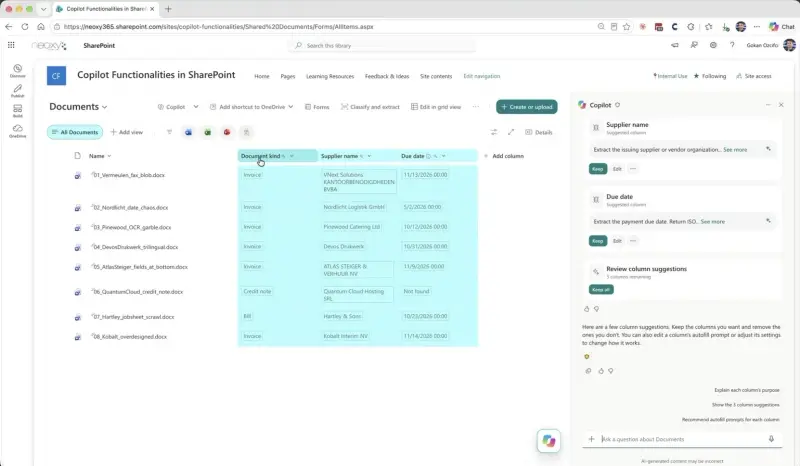
There is no Microsoft-supported way today to deploy autofill columns across hundreds of libraries through an API, PowerShell cmdlet, site template setting or content type hub option. The supported setup is per library. For ten libraries, that means configuring the prompt in each one.
Processing can scale differently from configuration. Standard autofill is covered by the Copilot license, and new files uploaded to a library are processed even when the uploader does not have a Copilot license. Real-time autofill metadata, which processes content as it arrives across the site, requires Copilot Credits and usage-based billing. Microsoft does not specify a file-count threshold for that work.
Community tools can automate setup, but they rely on undocumented interfaces. Leon Armston published a PnP PowerShell approach, and the CLI for Microsoft 365 has a command for setting autofill on a library column. Neither is supported by Microsoft. The underlying API may change, and the backend has changed since the original script was published, so that script may no longer work as written. Anyone evaluating these tools should test them carefully before using them across a tenant.
For supported extraction across multiple libraries, the options identified in the webinar were AI Builder models with Power Automate and Power Apps, Copilot Studio, and Azure Document Intelligence in Foundry Tools.
Keeping sites out of Copilot and managing HTML
When at least one person in an organization has a Microsoft Copilot license, SharePoint admins receive SharePoint Advanced Management features included with that license. Restricted Content Discovery is the control for keeping a site’s content out of organization-wide search and Microsoft Copilot responses. Copilot accesses organizational content through Microsoft Graph and the semantic index, while returning content the person asking is permitted to access.
Restricted Content Discovery excludes site content from organization-wide search and Copilot responses, including content people recently worked on. Copilot in SharePoint and its AI actions do not appear on the site. Users cannot use the ready-made agent, create agents there, or add that site’s content to other agents. The setting does not change direct access: people who already have permission can open the content, search within the site, and ask Copilot about a document they have open.
Admins can enable the setting for a site in the SharePoint admin center under Active sites, or use this PowerShell command:
Set-SPOSite -Identity <site-url> -RestrictContentOrgWideSearch $trueOther SharePoint Advanced Management controls cover different needs. Restricted Access Control limits a site to members of up to 10 groups; people outside those groups cannot open it even if they already have permissions or a sharing link, and search and Copilot honor the restriction. The block download policy allows browser access while preventing downloading, printing and syncing. Authentication contexts connect a Microsoft Entra Conditional Access policy to a SharePoint site.
Microsoft describes Restricted Content Discovery as a temporary governance control and recommends applying it selectively. For sites with more than 500,000 items, it can take more than a week to apply fully. Also consider its broader effect: it removes the site from organization-wide search and Copilot responses, not just Copilot in SharePoint.
There is no documented tenant-level setting to sanitize HTML generated by Copilot. SharePoint renders HTML pages in a sandboxed iframe with Content Security Policy rules. It blocks arbitrary fetch requests and outbound API calls. JavaScript runs only when included in the same HTML file, with exceptions for Microsoft-managed versions of selected libraries such as Chart.js and Mermaid. External links require a site admin to add the domain to HTML Field Security.
SharePoint does not provide a tenant-level control to disallow or restrict HTML pages. Site owners can turn off Allow HTML files in the Site Pages library. HTML pages, which let users publish an HTML file as a SharePoint page, are scheduled to reach general availability between mid-November and late December 2026, according to Message Center post MC1479517.
For external sharing risk, administrators can use the site’s external sharing settings, a data loss prevention policy with the “File extension is” and “Content is shared from Microsoft 365” conditions, or the block download policy on sensitive sites. Sensitivity labels do not apply at the file level because HTML is not among the supported SharePoint file types.
Admin priorities before the deadlines
Before November 1, 2026, review any use of the preview PowerShell settings KnowledgeAgentScope and its site list. Microsoft will stop honoring them after that date. If they currently limit Copilot in SharePoint to pilot sites or keep it off selected sites, plan for Copilot in SharePoint to appear on every site for every licensed user once the settings expire. Identify which sites truly need to remain excluded and enable Restricted Content Discovery where appropriate, accounting for its effect on organization-wide search and Copilot responses.
Before users begin advanced work at scale, decide who needs Copilot Credits and create a spending policy for Advanced work in SharePoint. Review existing policies to see whether they already allow the service. Microsoft’s guidance points toward content managers and site managers as the main groups to consider.
Between mid-November 2026 and the end of March 2027, inventory classic .agent files and plan a destination for each one. The agent registry, SharePoint Advanced Management agent reports and search can help locate agents. Route each agent according to its purpose: site questions may fit Copilot in SharePoint, repeatable processes may fit skills, and named retrieval experiences may fit Agent Builder. Recheck sharing permissions after migration, because Agent Builder agents have their own sharing model and usage history does not transfer.
For makers, a skill fits a repeatable process that Copilot should run; an agent fits a subject matter experience that answers questions. Skills run in Copilot in SharePoint and require a Copilot license for each user. Agents can also run in Teams and the Copilot app, including for users covered by pay-as-you-go. The most time-sensitive starting point is the classic agents already in use: their March 2027 retirement gives administrators a defined migration window.