- Subject
- Windows & PowerShell
- Filed
- Source
- IPWITHEASE
- Loans
- 321
AI Deployment Shifts Engineers from Writing Configs to Reviewing Them
AI speeds up drafts but puts more weight on precise requirements, technical review and controls for production systems and agents.
AI can produce a network configuration in seconds. Checking whether that configuration is safe, compatible with the deployed software and resilient to failure can take much longer. That shift captures what AI deployment changes for infrastructure and network engineers: less time spent drafting routine work, more time specifying requirements, reviewing outputs and taking responsibility for what reaches production.
The difference between trying an assistant and deploying AI into a production workflow is significant. A pilot might help a few engineers write scripts or troubleshoot. At scale, AI may draft configurations, change tickets and runbooks, triage alerts, or act through agents that call APIs. The first drafts become cheap; verification remains a skilled task, and accountability still rests with the people who approve changes.
Review becomes a core engineering task
AI-generated work can look polished while containing subtle errors. In a branch BGP example, an assistant might produce a complete configuration quickly, yet include an overbroad prefix list, syntax for a different operating system version, or local preference values that send traffic over the backup link. A simple lab with one uplink might not expose the last problem.
Engineers reviewing generated network configurations should check for several recurring failure types:
- Platform mismatches: Commands can belong to another vendor, operating system or software version.
- Excessive access: An access list, security group or prefix list may allow more traffic or routes than intended.
- Invented environment details: Addresses, VLAN IDs, autonomous system numbers and interface names may not exist in the actual network.
- Missing failure behaviour: A configuration may work in normal conditions but lack a sound response to a failed link, device or site.
- Outdated commands: Familiar-looking features may be deprecated or behave differently on current systems.
That makes deep technical fundamentals more valuable. Reviewing output is not just checking whether a command parses; it means understanding the routing, security and operational consequences behind it. Engineers increasingly act as editors and auditors, with the judgement to challenge a plausible-looking result.
Precise requirements determine output quality
When generating a draft is nearly effortless, explaining the desired outcome becomes the harder part. A broad request such as “write a BGP config for a branch” leaves important decisions open. A useful specification would state that the branch uses eBGP to two ISPs, has private AS 65010, advertises only 10.20.0.0/22, prefers ISP-A with local preference 200 and accepts only a default route.
The same principle applies to other infrastructure work. A firewall request should name the source, destination, permitted protocol and port, and logging behaviour. One example is allowing HTTPS from a DMZ web tier to application servers on TCP 8443 while denying and logging other traffic. A production VPC design needs constraints such as three availability zones, no public IPs on application or database subnets, NAT for egress and survival of a single-zone failure.
For an upgrade method of procedure, the request can specify the change window, pre-checks, rollback trigger and post-change validation commands. Clear constraints, naming standards and topology context help narrow the answer, while breaking large tasks into smaller pieces makes review more manageable. This is architecture work in daily practice: translating an operational need into technical intent that can be checked.
AI turns infrastructure into part of the workload
Once AI systems run beyond a notebook, infrastructure teams inherit decisions about where workloads run and how they connect. Inference may sit on premises, in a hyperscaler, on a GPU cloud or at the edge. Placement involves latency, data residency and cost. Training clusters can require high-bandwidth, low-latency east-west networks built around RDMA, RoCE, lossless Ethernet or InfiniBand.
Costs and operations also change. Token use, GPU hours and egress charges can accumulate, so teams need budgets, quotas, tags and cost dashboards. Service availability alone is an incomplete measure of health: monitoring may also need to cover latency, token throughput, error rates and model drift. Because AI applications call external APIs and retrieve information from multiple sources, secure egress, private endpoints and API gateways become part of the design.
Engineers who understand both the AI workload and the infrastructure underneath it are still uncommon. That combination helps teams make practical choices across compute, network, cost and service health as AI use grows.
New work: evaluations, guardrails and agent controls
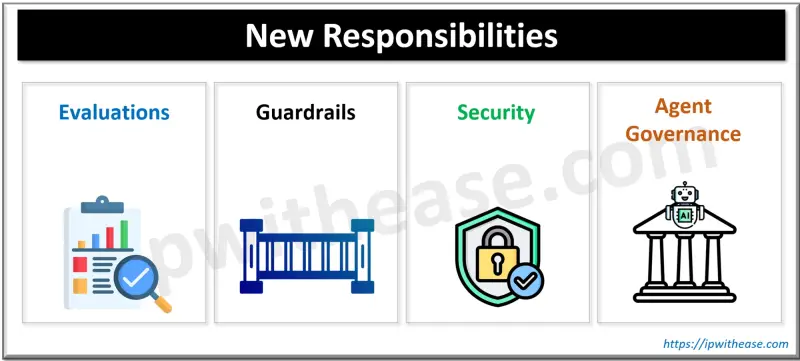
Production AI introduces engineering responsibilities that do not fit neatly into traditional pass-or-fail testing. Evaluations, or evals, use curated inputs and expected behaviour to assess whether a model, prompt or data source change improved results or made them worse. They need ongoing maintenance as systems change.
Guardrails cover input filtering, output validation, rate limits and fallback behaviour when a model times out or returns an unsuitable response. These choices have failure modes of their own and need to be designed and checked like other system components.
Security work includes considering prompt injection, data exposure through retrieval pipelines, over-permissioned service accounts and unsanctioned AI tools. Agents add a further control problem when they can open tickets, alter configurations or call APIs. Teams need to define permitted actions, record what agents do and set where human approval is required. Least privilege, a full audit trail and a clear way to stop an agent are practical safeguards.
How the skills mix is changing
Tasks built mainly on recall and repetition are becoming easier to automate. Memorizing command syntax and writing boilerplate scripts from scratch may distinguish engineers less than understanding why a design works, where it can fail and how to divide a problem into verifiable steps. First drafts of low-level designs and methods of procedure can be generated; judging whether those drafts are accurate and safe still takes experience.
Specializing in one tool or vendor also offers less reach than systems thinking across networking, cloud, security and data. Clear communication matters in both directions: engineers have to explain intent to colleagues and give AI tools enough context to produce useful work.
Preserve hands-on learning for junior engineers
Routine VLAN changes, small scripts and first-draft documentation have long helped junior engineers build experience. AI can now handle much of that work, which raises a training challenge: engineers need practice developing the judgement they will later use to review automated output.
Teams can ask juniors to explain every line of generated work before it enters a change request, give them troubleshooting problems that require reasoning, and pair them with senior engineers during reviews. Lab exercises can have them build a configuration by hand first, then compare it with an AI-generated version. The apprenticeship model can continue, but learning needs to be planned rather than left to routine task volume.
Where engineers can focus next
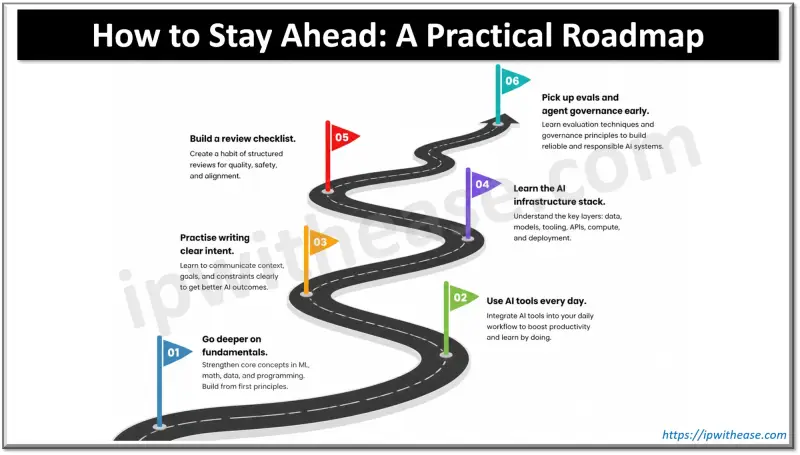
A practical development plan starts with fundamentals: routing, switching, distributed systems, security models and failure domains. These are the foundations for spotting errors that a confident assistant may present without warning. Regular use of AI tools on real tasks also helps engineers learn where those tools fail.
Write prompts as short design briefs with context, constraints and an expected outcome. Learn the infrastructure behind AI workloads, including GPUs, inference serving, vector databases and their supporting networks. Use a review checklist that covers platform syntax, addressing, security rules, failure behaviour and rollback. Evals and agent governance are also useful areas to develop as teams work out how to test model behaviour and control automated actions.
AI deployment changes what the job rewards: less time typing routine drafts, more time applying technical judgement and owning the result. A sound starting point is to choose one familiar task, let an assistant prepare a draft, and inspect it with the same care you would give work from a new team member.